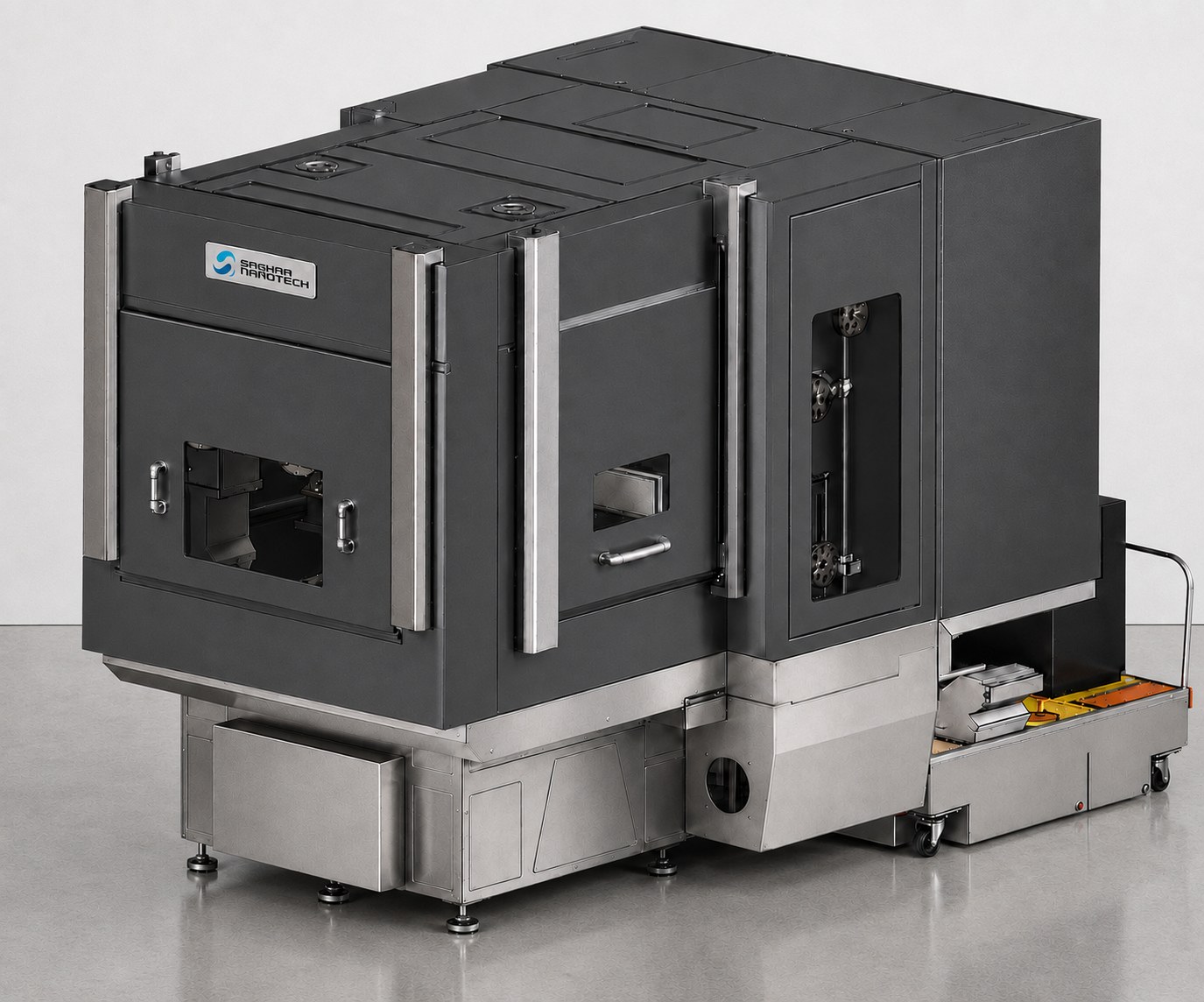
Rare Earth Permanent Magnet Multi Wire Sawing Machine
A dedicated machine that produces thin magnet plates and segments by cutting sintered rare earth magnet blocks with multiple diamond wires at once. Roller configuration and dedicated jigs are designed and built to match your magnet specification and production method.
Rare earth permanent magnets are expensive per unit of material and highly brittle, so yield and quality vary sharply with the cutting method you choose.
One face is cut at a time, so machining time rises in proportion to the number of pieces. Material disappears across the full thickness of the blade, which means cutting loss is high, and holding thickness gets harder the thinner the plate.
Multiple wire strands cut many faces at the same time, cutting the machining time per piece. The wire is thin, so cutting loss stays small and more plates come out of the same block. The ANT-WS1875UD pushes output per cycle further with its twin work table design.
The number of main rollers changes the shape and size of the cutting area the wire web forms. We select and build the roller configuration around your material specification, cutting method and target output.
One cutting area forms between the two rollers. The simplest structure, and the easiest to maintain.
An additional roller below gives two cutting areas, which is what allows the twin work table configuration.
The wire web encloses a rectangle, producing one tall cutting area in the centre. Suited to materials with a long cutting length.
A fifth roller below the rectangular layout secures two cutting areas. Applied where high volume or a combined layout is required.
As electrification and clean power generation expand, demand for precision cutting of rare earth permanent magnets grows with them.
Cuts magnet segments for traction motors, where high efficiency and high output are both required. Used for the segmented magnets that reduce eddy current losses.
Cuts the large magnets that go into permanent magnet generators to specification. Piece counts are high, so productivity and yield matter especially here.
Handles high-mix, low-volume items such as permanent magnets for high-efficiency servo motors and reducers, adapting flexibly through a change of jig.
Handles precision cutting of the small magnet components used in robot joint motors, where compactness and light weight are required.
※ These specifications are for reference only and may change without prior notice. Custom design and manufacture are available according to your material specification and production method.
Yes. We build to order in 2, 3, 4 and 5 roller configurations. The number of rollers changes the shape and the number of cutting areas the wire web forms, so tell us your material specification, stacking method and target output and we will propose a suitable configuration. Roller diameter is designed within a Ø150–Ø250 mm range; the ANT-WS1875UD standard is a 3-roller configuration at Ø180 × 750 mm.
The workpiece geometry and the way it is held are different. Silicon comes as a round ingot, so tilting and rotation mechanisms matter; a sintered magnet is a rectangular block, so bonding and jig pallet design are what count. The ANT-WS1875UD bonds magnet blocks to a beam and loads them on a pallet, and is built around a twin work table structure.
Sintered magnets are hard and highly brittle, so cracking and chipping occur easily during cutting. Electroplated diamond wire cuts with a fine wire in a grinding-like action, which reduces impact, and the narrow kerf also reduces the loss of expensive rare earth material.
Yes, and it comes down to the structure. Most of the machine is made from GC300 high-rigidity cast iron (equivalent to ASTM A48 Class 40), which resists deformation in a way a welded frame does not, and the roller shafts are supported at both ends inside an integrally cast housing to secure rotational accuracy. Coolant flows through channels cast into the body and draws heat away from the bearings directly: in our in-house measurements, applying this body cooling brought the main roller bearing temperature down from 65°C to 30°C. Because the body temperature stays constant, thermal displacement is suppressed and the roller axes do not drift out of alignment — so thickness variation stays under control and cut quality holds even over long machining runs.
Yes. Saehan Nanotech cuts customer material daily in its own machining division, so we can run tests based on your magnet material and target thickness. We propose wire specifications, cutting conditions and machine configuration from the test results, and the machining conditions (the recipe) are handed over with the machine.
Yes. Saehan Nanotech has been supplying wire sawing and core drilling equipment to the overseas magnet industry since 2011. Design, manufacture, inspection, installation and training are handled directly by our own engineers, and post-installation technical support is provided to the same standard.
Tell us your magnet specification, target thickness and monthly production plan and
we will review and propose a machine specification, roller configuration and jig design included.
Our engineering team responds within 1 business day with a tailored proposal.